The Message Is a Hypothesis. The Reply Is Evidence.
Most outbound advice starts with the same question:
“What’s the best cold email?”
Shorter? More personalized? More direct? Ask for a meeting? Offer something useful?
The problem is that this treats messaging as a copywriting exercise.
It isn't.
Every outbound message contains a set of assumptions:
- This is the right account.
- This is the right person.
- This is a problem they care about.
- The problem matters now.
- What we're saying is relevant enough to respond to.
- The next action we're asking for makes sense.
That makes the message a hypothesis.
And the response is evidence.
But the strength of that evidence depends on what the buyer actually tells you.
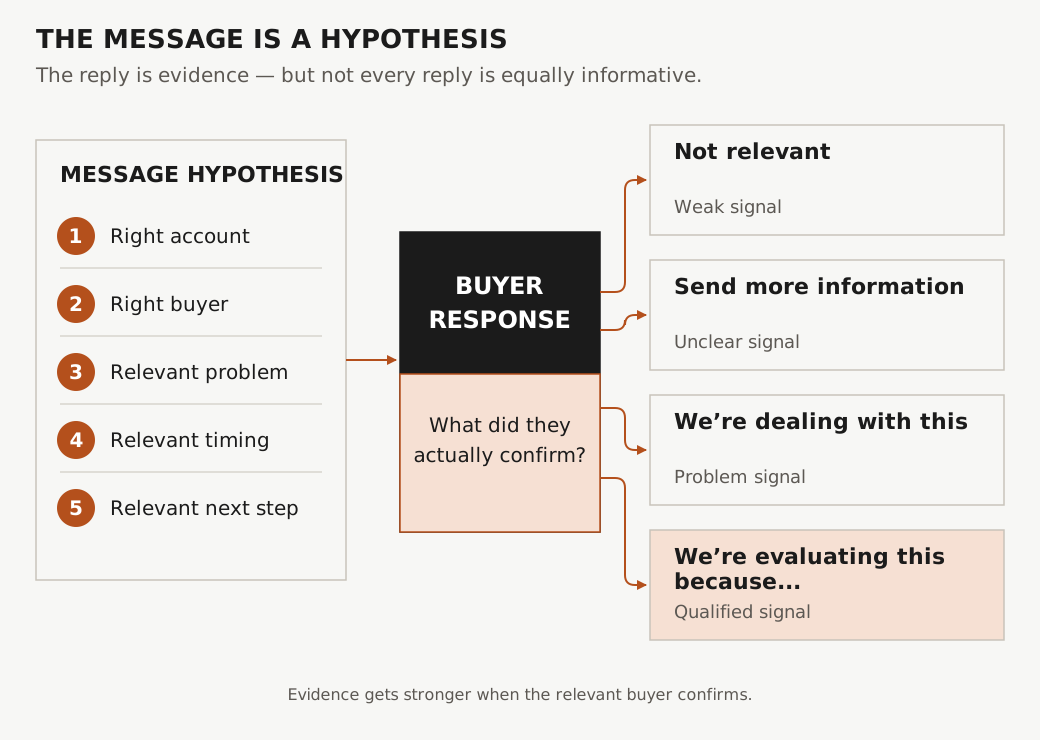
Conceptual model showing the assumptions embedded in the message and the different evidentiary strength of buyer responses
A reply is not necessarily a good result
Reply rate is one of the easiest outbound metrics to measure.
It's also one of the easiest to misunderstand.
A reply could be:
Those are not equivalent signals.
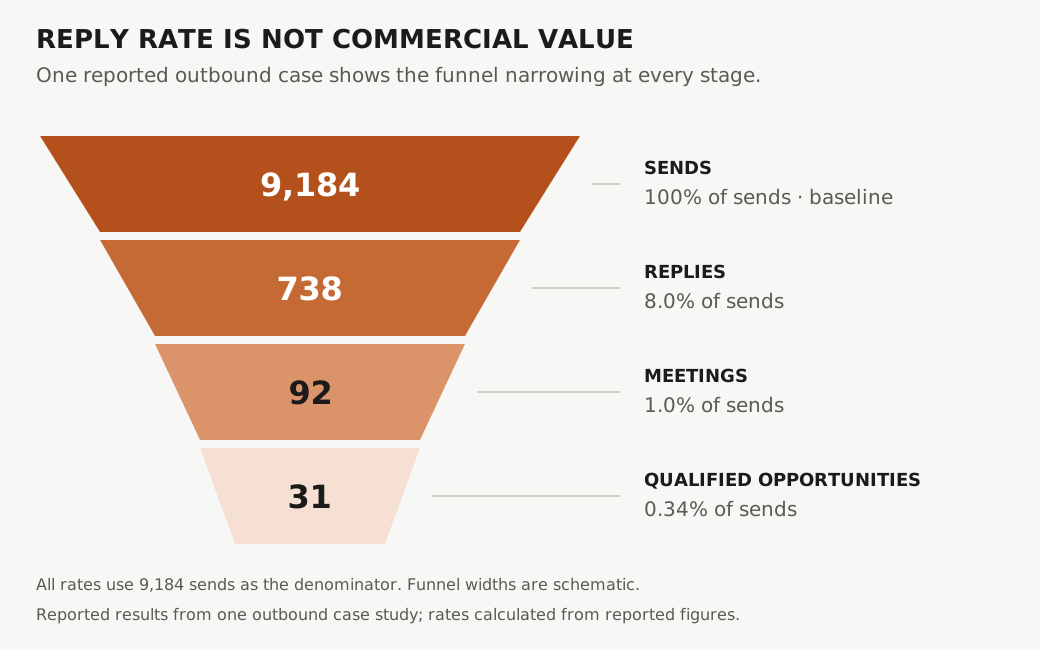
One self-reported B2B SaaS case study we reviewed makes the difference visible. Across 9,184 sends, the campaign reported 738 replies, 92 meetings, 31 qualified opportunities and 4 closed-won deals.
That means:
- 12.5% of replies became meetings
- 4.2% of replies became qualified opportunities
- 0.54% of replies became closed-won customers
Those are calculated from the case's reported numbers, not universal benchmarks.
The funnel gets smaller at every stage.
So:
Reply ≠ qualified buyer
Qualified reply ≠ meeting
Meeting ≠ opportunity
Opportunity ≠ customer
The useful question isn't simply:
“Did they reply?”
It's:
“What did the relevant buyer's response tell us?”
What appears to make a message more relevant?
The public evidence does not give us a universal winning formula.
Across the examples and datasets we reviewed, several patterns appear repeatedly — but the evidence is heterogeneous. Some sources are large observational datasets; others are self-reported experiments or case studies.
1. Specificity is worth testing
A generic message might say:
A more specific message might reference something observable about the company, its workflow or a problem it is likely dealing with.
In one founder-reported experiment, 250 prospects received a generic template and another 250 received a research-based version.
The reported reply rate was:
1.2% to 15.6%
The research-based group also reported 18 meetings and 4 deals, compared with none in the generic group.
That's an interesting signal.
But it is still one founder-reported experiment. The public source does not establish enough about randomization or independent verification for us to treat the 13× lift as a universal effect.
The defensible conclusion is simpler:
Specificity is worth testing.
2. Context is more useful than personalization for its own sake
There is a difference between:
and:
The second isn't merely personalized.
It's contextual.
It connects an observable account signal to a potential workflow problem.
In one B2B SaaS outbound case we reviewed, the campaign used hiring, expansion and operational signals to narrow the target list. Its first email connected a specific hiring signal to a hypothesized workflow problem.
The campaign reported strong results, but the source itself attributes those results to several factors: tight ICP, signal targeting, healthcare-specific copy and founder-led discovery.
So we shouldn't claim that the wording alone caused the outcome.
The more defensible lesson is:
Context gives the message a reason to be relevant.
3. Triggers give you a reason to test the hypothesis
A problem by itself may not be enough.
Why now?
Potential signals include:
- hiring
- expansion
- a new product
- a new market
- a leadership change
- an operational shift
- a strategic priority
But a trigger isn't proof that the prospect has the problem.
It's a reason to investigate the hypothesis.
So:
Trigger: hypothesis
not:
Trigger: certainty
This distinction matters for Eygentic because previous ICP research identified buyer and trigger evidence as areas that still require customer validation.
Outbound can help test those assumptions.
4. The first CTA doesn't always need to be a meeting
This is where the public evidence is particularly useful.
Gong analyzed 304,174 emails and defined a positive outcome as a meeting booked within 10 days. In that analysis, interest-oriented CTAs performed better than meeting-oriented CTAs for cold email.
That is evidence about meeting outcomes, not proof that interest CTAs generate better customers.
Other self-reported Shopify experiments point in a similar direction: free-resource or specific-insight offers reportedly generated more replies than direct demo requests.
Again, that does not establish a universal rule.
It suggests something more useful:
The CTA itself is part of the experiment.
A stranger may not be ready to give you 30 minutes.
They may be willing to answer:
That's a smaller commitment.
And that makes the CTA another hypothesis to test.
The message is the experiment
Before sending an outbound message, you should be able to answer four questions.
What do we believe?
This type of company has this problem.
Why do we believe it?
We observed this account, workflow or trigger.
What are we testing?
If we describe the problem this way, the buyer will recognize it as relevant.
What would support the hypothesis?
Not just:
“Someone replied.”
But:
“The relevant buyer confirmed that this is a problem.”
That's the difference between outbound as activity and outbound as learning.
Not all buyer responses carry the same evidence
A useful working framework is to classify responses by the amount of information they give you.
Negative
Possible learning: The account, buyer or problem hypothesis may be wrong.
Neutral
Possible learning: There may be some interest, but intent is unclear.
Positive
Possible learning: The problem hypothesis has some support.
Qualified
Possible learning: You now have evidence about the problem and its context.
For this article, a qualified reply means a response from the relevant buyer or stakeholder that provides evidence about the hypothesized problem, workflow, trigger or active evaluation.
That still isn't ICP validation.
One reply is one data point.
Its value increases when:
- the responder is actually relevant
- the problem matches the original hypothesis
- the account fits the intended ICP
- the response contains specific context
- similar signals appear across multiple accounts
- downstream behavior supports the signal
So a reply is not automatically “customer evidence.”
It is customer-side evidence whose strength depends on what the buyer actually confirms and what happens next.
Read replies as research data
This changes how you measure outbound.
Instead of tracking only:
- Sent
- Replies
track:
- Sent
- Replies
- Qualified replies
- Meetings
- Opportunities
- Customers
And preserve the qualitative information too.
| Metric | What it tells you |
|---|---|
| Sent | Your denominator |
| Replies | Initial engagement |
| Positive replies | Initial resonance |
| Qualified replies | Buyer/problem signal |
| Meetings | Commercial interest |
| Opportunities | Pipeline signal |
| Customers | Business outcome |
| Reply themes | Qualitative learning |
The last row is easy to overlook.
A reply isn't just a number to add to a dashboard.
It can contain information about:
- the buyer
- the problem
- the workflow
- the language they use
- the trigger
- the urgency
- whether your original hypothesis was actually right
And sometimes the most useful evidence is negative.
One founder building an AI customer-support agent reported sending 170 cold emails to Heads of CS at funded SaaS companies and getting zero replies. They later changed the target toward small, founder-run SaaS companies where the founder was personally dealing with support and reported getting a trial customer.
That doesn't prove the new ICP was universally better.
It does demonstrate an important possibility:
The problem may be who you're messaging, not how beautifully you've written the message.
Build a messaging learning loop
Don't endlessly rewrite templates.
Treat each campaign as an experiment.
This is a recommended learning framework, not a proven formula for increasing revenue.
The public evidence is not strong enough to claim that following this loop will automatically improve conversion or pipeline.
What it gives you is something more practical:
a way to turn outbound activity into evidence.
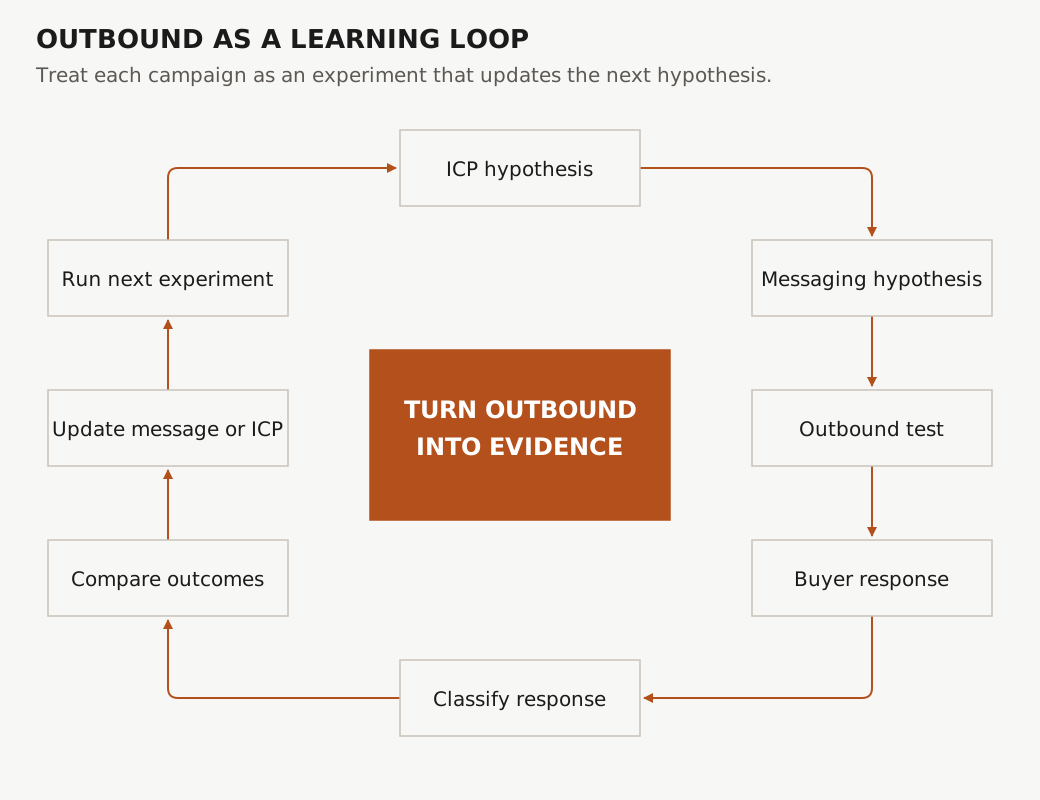
Conceptual framework: treat each campaign as an experiment, classify the response, compare outcomes, and update the next hypothesis
Outbound can be a customer-research system
This is where Eygentic's approach starts to differ.
Outbound isn't only a channel for generating conversations.
It can also be a way to collect evidence that improves the ICP and positioning behind those conversations.
The previous Eygentic research starts with a similar principle:
account + problem + workflow can create useful ICP hypotheses, while buyer + trigger still require customer validation.
Now extend that into outbound:
- Who do we think has the problem?
- What do we think matters to them?
- What message tests that assumption?
- What does the buyer say?
- What should we change?
That's a much more useful way to think about messaging than searching for the perfect template.
The Takeaway
Don't ask:
“What's the best cold email?”
Ask:
“What am I assuming about this buyer, and what message would let me test that assumption?”
Then measure more than the reply. Separate engagement from qualification, look for repeated signals, and compare them with downstream outcomes.
Use what you learn to shape the next experiment.
The message is the hypothesis.
The reply is the evidence.
If you're testing outbound and want to turn buyer responses into a repeatable learning loop, reach out to Eygentic to discuss how you can structure those experiments.
Evidence note
This article uses large observational datasets, comparative experiments and self-reported case studies as directional evidence.
The evidence supports patterns worth testing, not a universal messaging formula.
Where a source is observational, self-reported or changes multiple variables at once, that limitation matters. Public research rarely exposes the complete chain from message to reply to qualified buyer to meeting to opportunity to customer.
That missing evidence is exactly why outbound should be treated as a learning mechanism rather than as proof that one template will work everywhere.
Methodology
We reviewed public outbound research across datasets, experiments, and case studies, checking the reported numbers, outcomes, and methodological limitations. Findings were separated from calculations, inferences, and hypotheses. The evidence is used to identify patterns worth testing, not to claim a universal outbound formula.
Sources
- Gong — Cold Email Analysis
- Gong — Cold Email CTA Analysis
- Jetwheel — “Show Me You Know Me” Cold Email Experiment
- Growtoro — SaaS Outbound Case Study
- Seed — Shopify Cold Email Benchmarks
- B2BRepurpose — Shopify Personalization Experiment
- B2BRepurpose — Shopify Offer Experiment
- Indie Hackers — AI Customer-Support Outbound Case Study
- Loom / Intercom — Personalized Prospecting Case Study
- Backlinko / Pitchbox — 12M Outreach Email Study