No Case Studies? Build Proof Buyers Can Inspect.
How early-stage AI startups can help buyers evaluate a product before a long customer track record exists.
You have built an AI product. You can demonstrate what it does, explain how it works and show examples of its results.
Then a potential customer asks for case studies.
You do not have many yet.
That creates an awkward gap. You believe in your product, but the buyer has limited evidence of how it performs beyond your own demonstrations.
And the buyer has a reasonable concern: How do I know this AI product will work for my use case, and what happens when it doesn't?
You cannot manufacture a customer history you do not have. But you can make your product claims easier to examine.
The starting point is not a bigger promise. It is clearer evidence.

A demo shows what can happen. Evidence shows what was tested.
Imagine an AI assistant that drafts customer support responses.
During a demo, it produces a helpful answer to a straightforward question. The buyer sees the intended experience.
But what happens when the question is ambiguous? When the information is incomplete? When the assistant confidently produces an incorrect answer?
A successful demonstration does not, by itself, answer those questions.
To evaluate an AI product, a buyer needs to understand what was tested, what counted as an acceptable result, where the system struggled and how errors are handled.
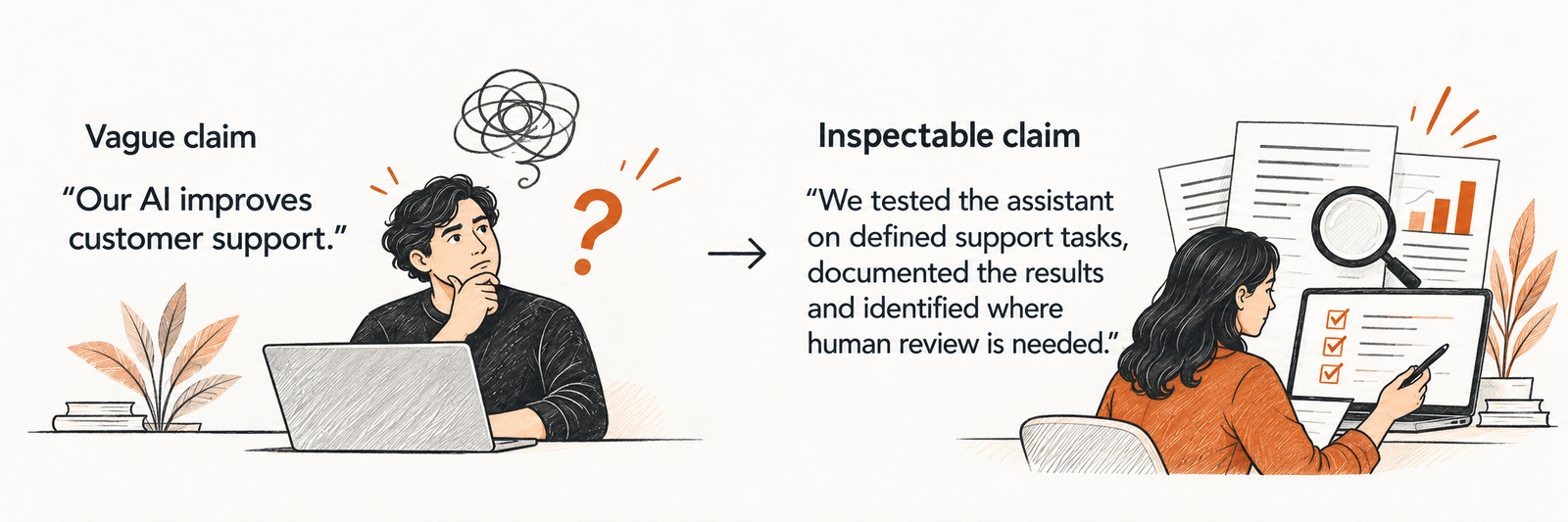
That changes the conversation from:
“Our AI improves customer support.”
To something more specific:
“We tested the assistant on defined support tasks, documented the results and identified the situations where human review is needed.”
The second statement is not automatically more persuasive. Its value is that the buyer can ask to inspect the evidence behind it.
A claim becomes easier to evaluate when you show what supports it, and where that support ends.
What can you show when you have no case studies?
You do not need to create a large documentation pack just to appear established. Start with the questions a buyer needs answered.
1. Show what you tested
Test a specific AI capability. Do not try to prove that the entire product works.
Document:
- Tasks and conditions: What you tested and how.
- Evaluation criteria: How you measured performance.
- Results: What you observed and which product version you tested.
- Test ownership: Who conducted the evaluation and when.
Explain how you selected examples and assessed results. Label internal evaluations clearly. They are not independent validation.
Test results apply to the conditions you tested. They do not prove that the product will perform equally well in every workflow or in production.
2. Show where the product fails
AI systems can produce incorrect, incomplete or inappropriate outputs. Document known limitations, representative failures and untested conditions.
Also show how the product handles errors. Depending on its intended use, this may include:
- Human review before a response reaches a customer.
- Permission and confirmation checks before an AI system takes action.
- Escalation and recovery procedures when something goes wrong.
The right controls depend on the consequences of an error. A policy that promises human oversight does not prove that human review works in practice.
3. Answer the operational questions
Good AI product performance does not automatically make a product suitable for an organisation.
Buyers may need information about:
- Data handling and retention.
- Access controls and subprocessors.
- Deployment requirements.
- Security, privacy and incident procedures.
Provide relevant documentation and state what has and has not been assessed. A vendor questionnaire is not the same as an independent audit or certification.
Official guidance offers useful starting points. The UK government's AI procurement guidance discusses proof-of-concept evaluations. Canada's ISED implementation guide for AI systems recommends documenting testing methods and known limitations. NIST's AI Risk Management Framework resources cover test sets, metrics and evaluation methods.
These are recommendations, not proof that every buyer requires the same evidence.
4. Test the product against the buyer's use case
Existing evidence may not answer the buyer's main question. A scoped pilot or proof of concept can help test the product in the intended workflow.
Before the test, agree on:
- Tasks and constraints: What the product will be tested against.
- Success and failure criteria: How results will be judged.
- Responsibilities: Who will run and review the test.
- Next decision: What the results will determine.
For an AI support assistant, this might include response quality, factual errors and the amount of human review required.
A successful pilot does not guarantee production readiness or a purchase. Budget, implementation effort, security requirements and internal ownership may still affect the decision.
The goal is to answer a specific question, not to remove every uncertainty.
Make your claims inspectable, not bigger
When you lack customer references, it can be tempting to compensate with stronger messaging.
But stronger wording does not remove uncertainty.
Instead, separate four things:
- What you tested: The task, conditions and evaluation method.
- What you observed: The result within those conditions.
- What you infer: What the result might mean for the intended use case.
- What remains uncertain: The limitations, untested situations and questions that need further evaluation.
This distinction helps prevent a narrow test from becoming a broad product promise.
It also makes it easier for a buyer to identify what the evidence answers and what still needs to be checked.
None of this means customer references, independent validation or production history no longer matter. A buyer may still require them. Inspectable evidence is a way to be transparent about what you can demonstrate today, not a substitute for every form of assurance.
Turn the idea into a practical next step
Before your next buyer evaluation, work through five questions:
- What is the specific claim? Choose one capability or outcome to examine.
- What could go wrong? Consider the consequences of an incorrect result, the data involved and the system's authority to act.
- What evidence addresses that risk? Choose a relevant evaluation, failure example, operational document or scoped pilot.
- What are the limits? State what was tested, what the results show and what remains unknown.
- What decision comes next? Agree with the buyer on what has been resolved and what, if anything, needs further testing.
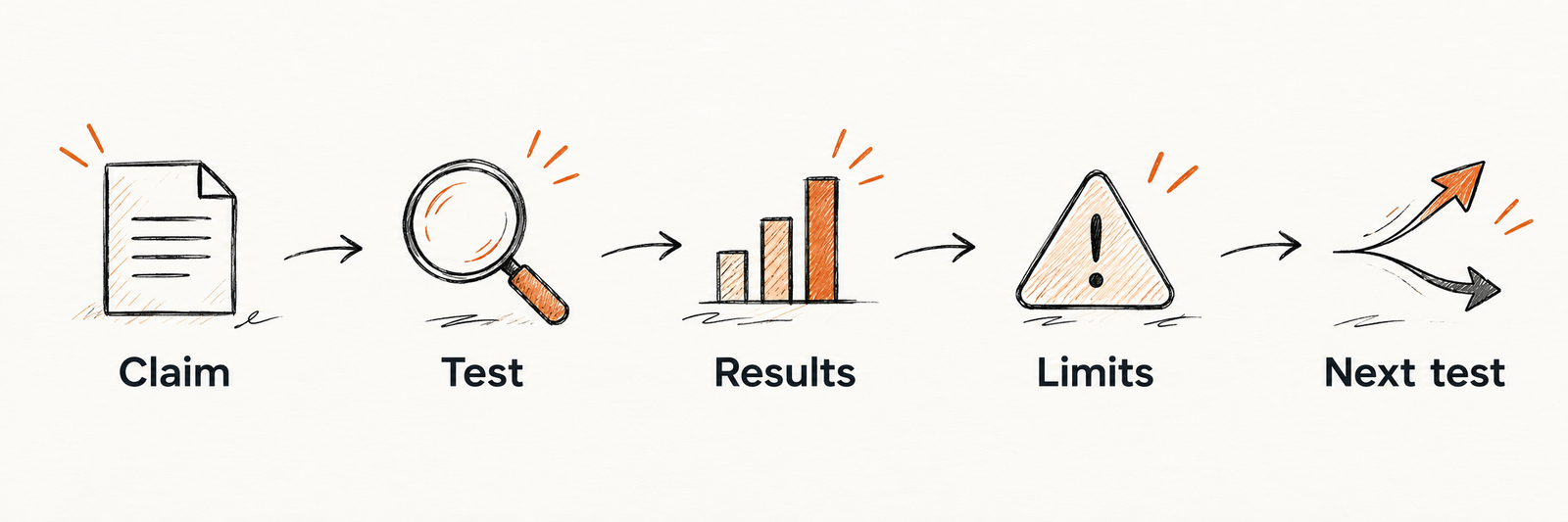
This is a starting point, not a universal checklist. A low-consequence drafting assistant and a system that takes consequential external actions will need different kinds of evaluation.
The aim is not to make every uncertainty disappear. It is to make the next evaluation more concrete.
Proof is one part of the picture
Making your product claims easier to inspect is a useful starting point. But it leaves another question:
Are you showing the right evidence to the buyers who care about it?
That depends on more than the product. It depends on who you are targeting, what those buyers value, how you explain the problem you solve and what you learn from actual buyer responses.
These are questions worth testing rather than assuming.
At Eygentic, we work on the go-to-market side of that challenge: helping startups test their audience, messaging and acquisition approach to learn what generates genuine buyer interest.
If you are working out which audience, message and proof points to test next, book a discovery call with Eygentic.
Sources: This article draws on the UK Government’s AI Procurement Guidelines, Canada’s ISED Implementation Guide for AI Systems, and NIST’s AI Risk Management Framework Measure Playbook. These sources provide guidance on AI evaluation, testing methods, known limitations and proof-of-concept approaches.
Methodology: We reviewed official guidance to identify practical ways early-stage AI startups can demonstrate product capabilities, document limitations and evaluate use cases. The recommendations are guidance-based, not proof that these practices guarantee buyer trust or sales.