Your First Customers Came From Your Network. What Happens When It Runs Out?
At Eygentic, we work on a question many early-stage AI founders eventually face: how do you turn early customer wins into a go-to-market process you can repeat? Your first customers may come through personal introductions, former colleagues or founder networks. That is a useful start, but it can become difficult to sustain when growth depends on who you already know. Eygentic helps AI startups diagnose GTM bottlenecks, sharpen their understanding of the right customers and run structured experiments to find what can work beyond the founder’s immediate network.
Getting your first customers proves that people are willing to buy your product. It does not necessarily show that you know how to find the next ones consistently.
Your first customers probably did not come from a polished go-to-market strategy. Someone you knew introduced you to a buyer. A former colleague recommended your product, or a founder in your network agreed to give it a try. One conversation led to another, and soon you had your first few customers.
There is nothing wrong with starting this way. The challenge comes when you need to do it again. People are willing to pay for your product, but you may not know where the next ten customers will come from. Referrals can be unpredictable, cold outreach may get mixed results, and the approach that worked with people who already trusted you may not work as well with strangers.
Can you win your next customer without relying on the same connections that helped you get your first one?
That is the difference between getting early traction and building a go-to-market (GTM) process you can repeat.
What the 30-source review found
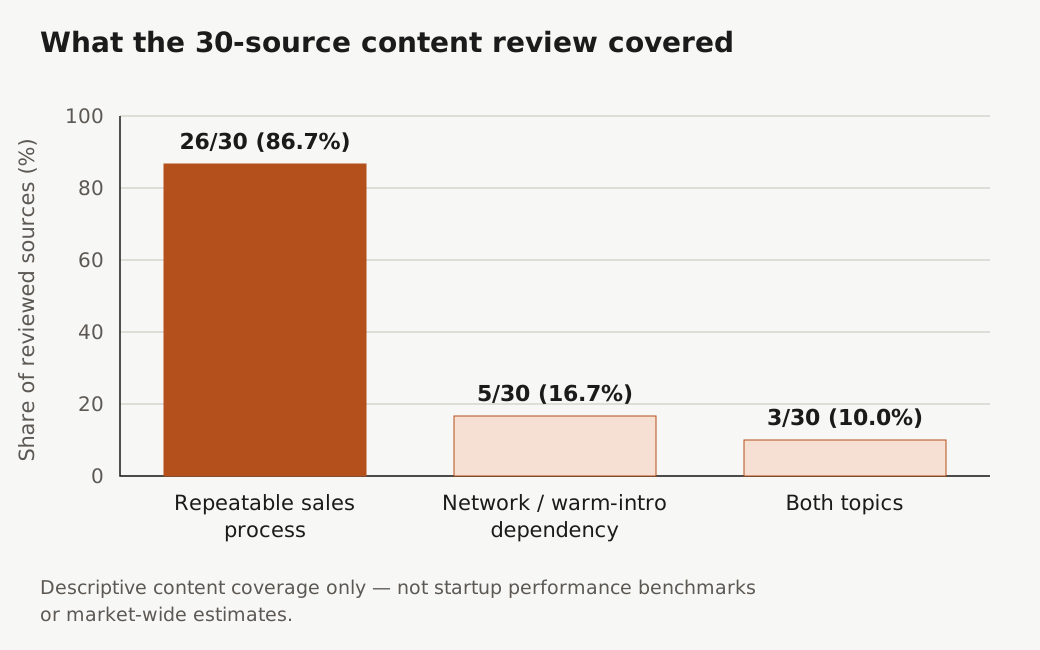
These are content-coverage figures from the reviewed sample,not industry benchmarks, startup performance metrics or market-wide estimates.
1. Early traction can hide an acquisition problem
Founder-led sales makes sense in the early stages. Founders can talk directly to customers, hear their concerns, sharpen the product message and learn what makes people buy. Warm introductions help, too, because some trust is already there before the first sales conversation.
But a sale can happen for several reasons. The product may solve a real problem, the customer may fit your ideal customer profile (ICP), or the founder may already have a strong relationship with the buyer. The introduction itself might carry trust, or the timing may simply be right. Often, several of these things happen together. A closed deal alone will not tell you which factor mattered most.
This is where it gets tricky. A startup can take early sales as proof that its acquisition process is working, even when those sales depended heavily on the founder's relationships. The answer is not to stop using your network. It is to understand what those first wins really tell you.
2. What does the existing GTM advice already cover?
To see what existing advice already covers, we reviewed 30 public articles, guides, interviews and playbooks about startup sales, founder-led sales, pipeline development and repeatable customer acquisition.
We then manually checked which topics each source discussed explicitly.
| Topic | Sources | Share |
|---|---|---|
| Repeatable sales processes | 26 / 30 | 86.7% |
| Founder networks / warm introductions | 5 / 30 | 16.7% |
| Both topics explicitly | 3 / 30 | 10.0% |
Repeatable sales is already covered by many of the sources in our sample. For example, Stripe's guide to finding first customers recommends starting with existing connections while also developing new leads. HubSpot's guide to building a scalable sales process looks at the difference between early wins and a sales motion that has been tested.
Sources: Stripe Atlas , https://stripe.com/guides/atlas/starting-sales | HubSpot for Startups , https://www.hubspot.com/startups/resources/gtm/early-stage-scalable-sales-process
3. Five questions to diagnose your GTM motion
Before blaming your network, look at how your customers found you and what convinced them to buy.
Question 1: Where did your customers come from?
Start with your actual customers rather than guessing. Record how each one first heard about you, whether through a personal introduction, referral, outbound, inbound, a partnership or another channel. Keep the original source separate from the conversations that followed.
What to look for: Do most customers come through personal connections, or are other channels also bringing in qualified opportunities?
Referrals are not a problem by themselves. The question is whether they arrive reliably enough to support your growth plans.
Question 2: Are your customers actually similar?
Your early customers may have bought for very different reasons. One may have needed a particular integration, another may have trusted the founder, and a third may simply have wanted to experiment with new technology.
Compare their industry and company size, the person who made the decision, the problem they needed to solve, what triggered the purchase, why they chose you and how they use the product.
What to look for: Can you find a clear group of customers who share a similar problem and a similar reason for buying?
Question 3: Can you explain why those customers bought?
Early sales conversations teach founders a lot, but those lessons can stay in their heads instead of becoming useful for the rest of the team. Write down what made the problem urgent, what convinced the buyer, which objections came up, who was involved in the decision and what happened between the first conversation and the purchase.
What to look for: Do your successful deals have clear patterns, or does every win seem to have a different explanation?
Question 4: Can you generate new opportunities without a warm introduction?
Pick one channel to test instead of trying to scale everything at once. For example, choose a specific customer segment and run a focused outbound experiment. Decide which accounts to target, whom to contact, what to say, how to follow up and how long you will run the test before you begin.
Track each step, from the people you contact to meaningful replies, qualified conversations and real opportunities. Do not draw a big conclusion from one reply or a few conversations. You may not have enough evidence yet to know whether the approach is working.
What to look for: Can you tell which audience and message brought in good opportunities, what did not work and what you will change next time?
Question 5: Does the process depend on the founder?
It is normal for founders to be involved in sales at this stage. You do not need to remove them from every conversation straight away. First, work out which steps rely on personal relationships, knowledge that has never been written down or decisions only the founder knows how to make.
Could another team member find a suitable prospect, explain the value, qualify the lead, answer common objections, follow the process and record the outcome?
What to look for: Which parts of the process can someone else follow, and which still depend on the founder?
4. Build a repeatability test,not another vanity metric
There is no magic number of customers, referrals or outbound messages that proves your GTM is repeatable. A company selling an affordable product to small businesses will have a very different sales process from a company selling an enterprise AI platform with a long procurement cycle.
Instead of relying on a generic benchmark, start with your own customer and pipeline data. That gives you a baseline you can actually compare against.
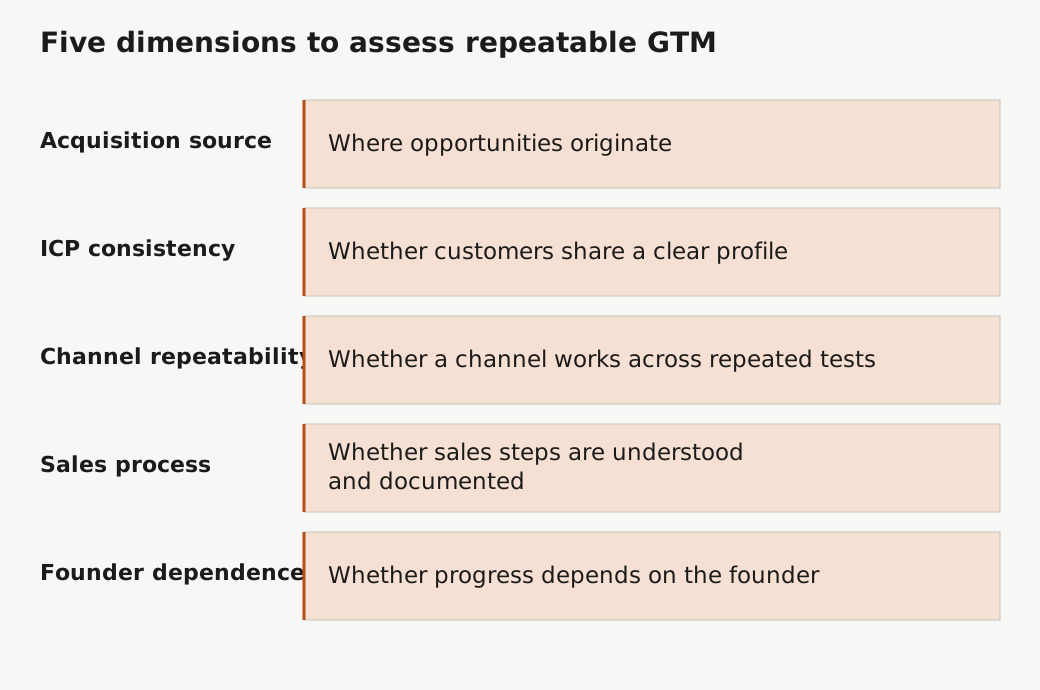
| Dimension | What to measure | Evidence to collect |
|---|---|---|
| Acquisition source | Share of opportunities by source | CRM records and original lead source |
| ICP consistency | Similarity of qualified customers | Firmographics, buyer roles and use cases |
| Channel repeatability | Whether a channel generates qualified opportunities over repeated tests | Campaign and pipeline records |
| Sales process | Whether sales steps are understood and documented | Sales stages, conversion and deal notes |
| Founder dependence | Which activities require founder involvement | Deal ownership, documented process and handoffs |
5. What should founders do when the network stops producing enough leads?
You do not necessarily need to abandon founder-led sales or hire a sales team right away. Start by fixing the problem your diagnosis uncovers.
If you are unsure about your ICP, compare your existing customers and look for the segment with the clearest, most consistent need. If your value proposition is not landing, review both successful and unsuccessful sales conversations. If leads are inconsistent, test one channel with a defined audience, message and measurement plan. If deals are not converting, look at qualification, objections and where conversations stall. If everything depends on the founder, document what works and see whether another team member can follow the same steps.
For each change, write down what you expect to happen, how you will measure it and when you will review the results. If the evidence does not support your assumption, adjust the approach before investing more in it.
This is also where an outside perspective can help. Eygentic focuses on helping AI startups make sense of GTM uncertainty through focused research, clearer diagnosis and structured experiments, so teams can decide what to test next instead of scaling a guess.
6. The real milestone is repeatability
Your first customers are important. They bring revenue, feedback and proof that someone is willing to pay for what you have built. But moving to the next stage requires a different kind of proof.
You need to know who buys, why they buy, how you reach them, what helps a deal move forward and which steps you can repeat. This does not mean referrals need to disappear. If referrals arrive consistently, they can be a strong acquisition channel in their own right. And not every startup needs outbound sales, a large sales team or a complicated CRM.
Early traction shows that customers can find their way to you. Repeatable GTM helps you understand how to make that happen again.
Methodology and limitations
The figures in this article come from a preliminary manual review of 30 public pages about startup sales and GTM. We checked each source for explicit discussion of repeatable sales processes, reliance on founder networks and related topics.
The sources were selected for relevance, not chosen at random. The percentages describe only the sources we reviewed. They do not show how common network-dependent acquisition is among startups, prove that a gap exists across the whole market or tell us which GTM approach works best.
To strengthen these findings, the next step is to review more sources, verify the coding against the full articles and collect evidence from founders or documented startup case studies.
SEO details
SEO title: Your First Customers Came From Your Network: How to Build Repeatable GTM
Meta description: Learn how to diagnose founder-network dependency, assess early customer traction and identify the GTM bottleneck preventing repeatable customer acquisition.
Primary keyword: repeatable go-to-market strategy
Related keywords: founder-led sales; startup customer acquisition; B2B SaaS sales process; early-stage GTM; founder network dependency
If this sounds familiar, Eygentic can help you examine where your current GTM motion depends on relationships, where the process breaks down and which experiment is worth running next. The goal is not to replace what is already working. It is to understand why it works and build a more repeatable way to do it again.