Same label, Different Products: What 50 Customer support AI Vendors can tell you about your ICP
Vendor research surfaces problem, workflow and product-fit signals. It cannot validate an ICP. Here is what the evidence supports, and what still needs customers.
Read the websites of 50 Customer Support AI vendors and the category looks settled. Thirty-four of the 50 sit in three familiar label families: AI support or helpdesk, agent or autonomous systems, chatbot or conversational AI.
Read them closely and the picture breaks. Under the same label, one product answers questions from a help center, another takes actions in CRM and billing systems, another works inside Slack, another can be self-hosted, and another reads support conversations for insight instead of answering them.
That is a problem for anyone writing an ICP. If category language can’t separate products, it can’t separate customers either.
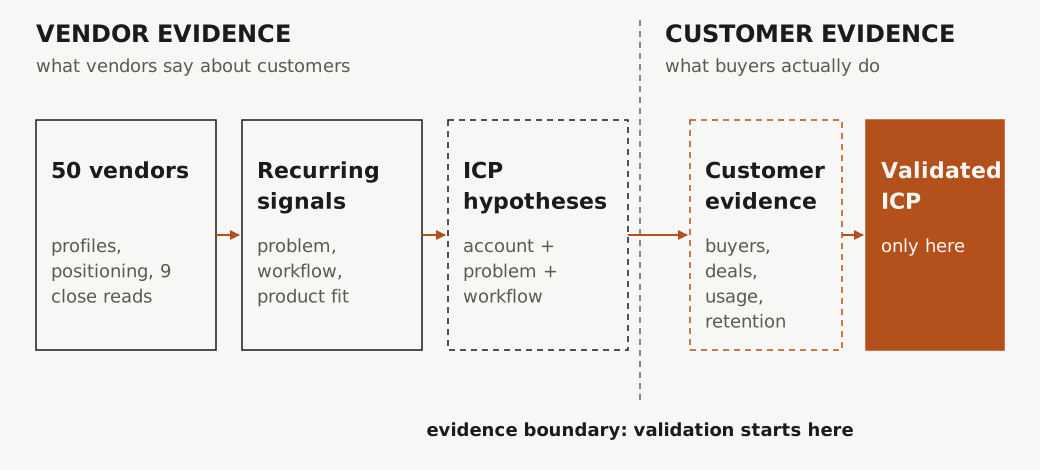
We analyzed 50 vendors and read nine of them closely, looking for recurring problem, workflow and product-fit signals. We found some. We did not find an ICP, and vendor research can’t produce one. Buyer, trigger, urgency, economics and retention only appear in customer evidence. What the research did was narrow what needs testing.
” The language overlaps more than the underlying products do”.
01 : The Research Question
Why study vendors to learn about customers?
An ICP is a claim about which accounts will buy, succeed and stay. Vendors can’t prove that claim, but they make versions of it constantly: who they serve, what pain they solve, where the product runs. We treated those statements as raw material for hypotheses, not as facts to adopt.
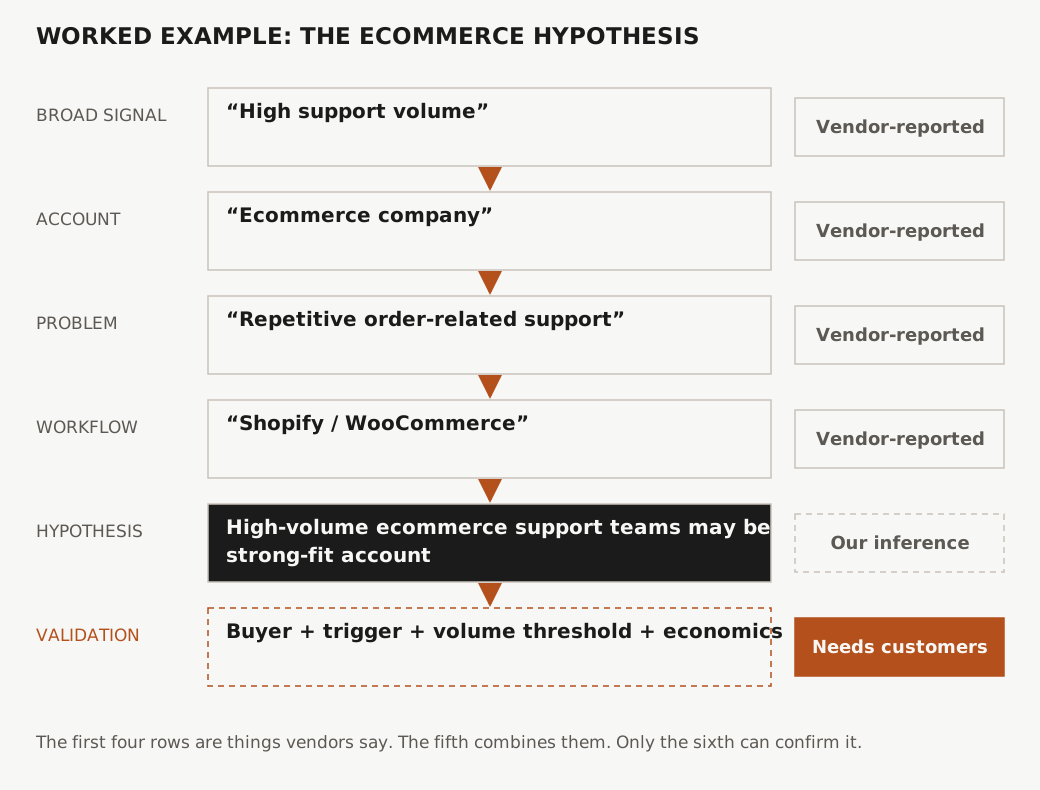
For each vendor we recorded industry, size, use case, pain, buyer message, trigger, positioning and differentiator, then coded and counted what recurred. Figure 1 shows where that evidence stops.
02 : What Repeats across the Category
Which signals recur across the 50 vendors?
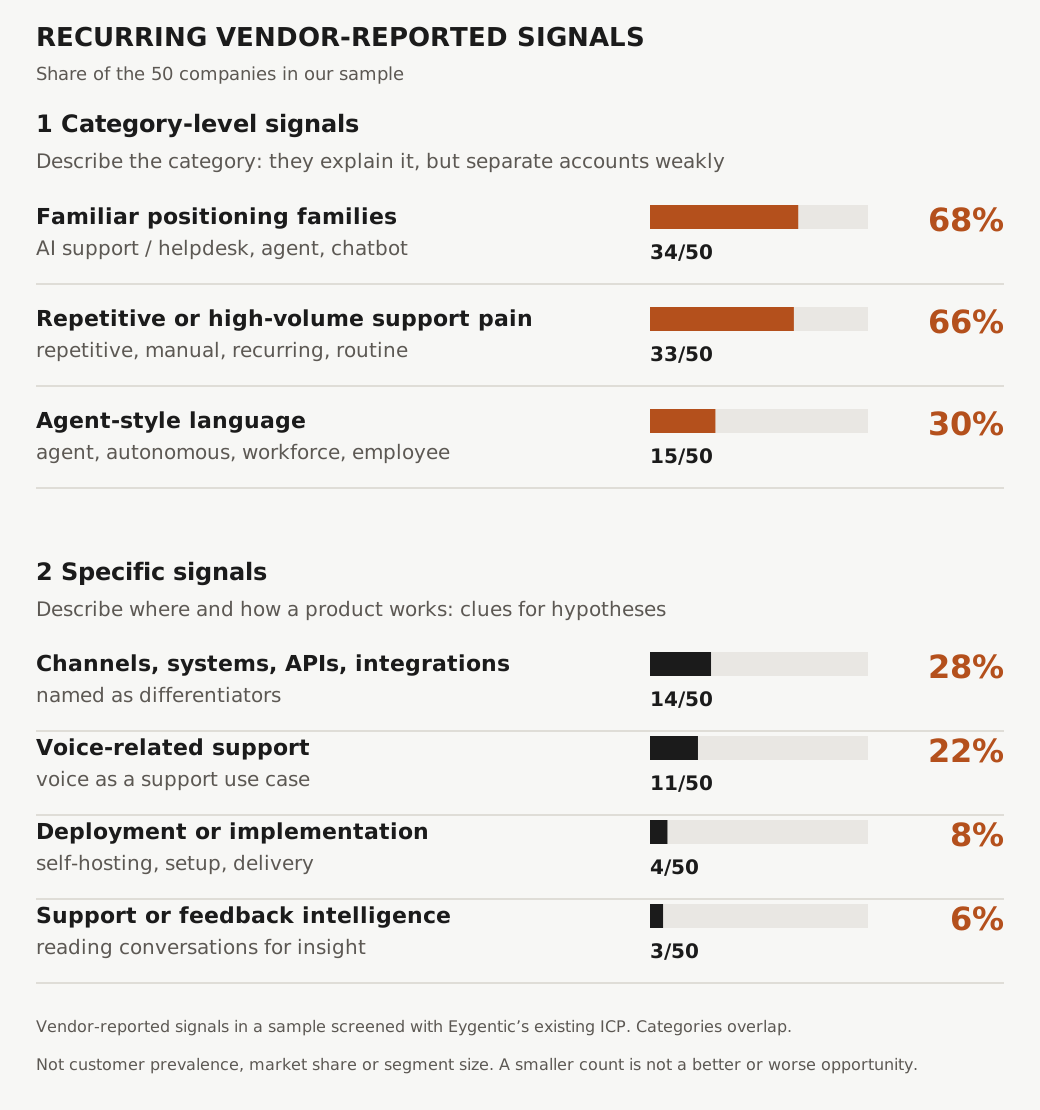
Two signals dominate. 33 of 50 companies (66%) describe repetitive, manual, recurring or high-volume support work. 34 of 50 (68%) use one of the same three label families. Fifteen (30%) add agent, autonomous, workforce or employee-style language.
These signals are common. That makes them useful for understanding the category and weak for separating one account from another. A pain that two-thirds of vendors claim to solve can’t tell you which customer a given vendor will win.
The smaller counts describe where and how a product works: 14 of 50 (28%) name channels, systems, APIs or integrations as a differentiator, 11 (22%) include voice, 4 (8%) differentiate on deployment or implementation, and 3 (6%) on support or customer-feedback intelligence. Small does not mean better.
These signals matter because an account can be matched against them.
“ Common signals explain the category. Specific signals help form the hypothesis. “
03 : What Disappears underneath the Labels
How different are products that sound the same?
Five of the nine close reads use agent wording: Quidget, Leave It AI, GoodBox.ai, InteraOne and ClearFeed. The word is shared. The product jobs are not.
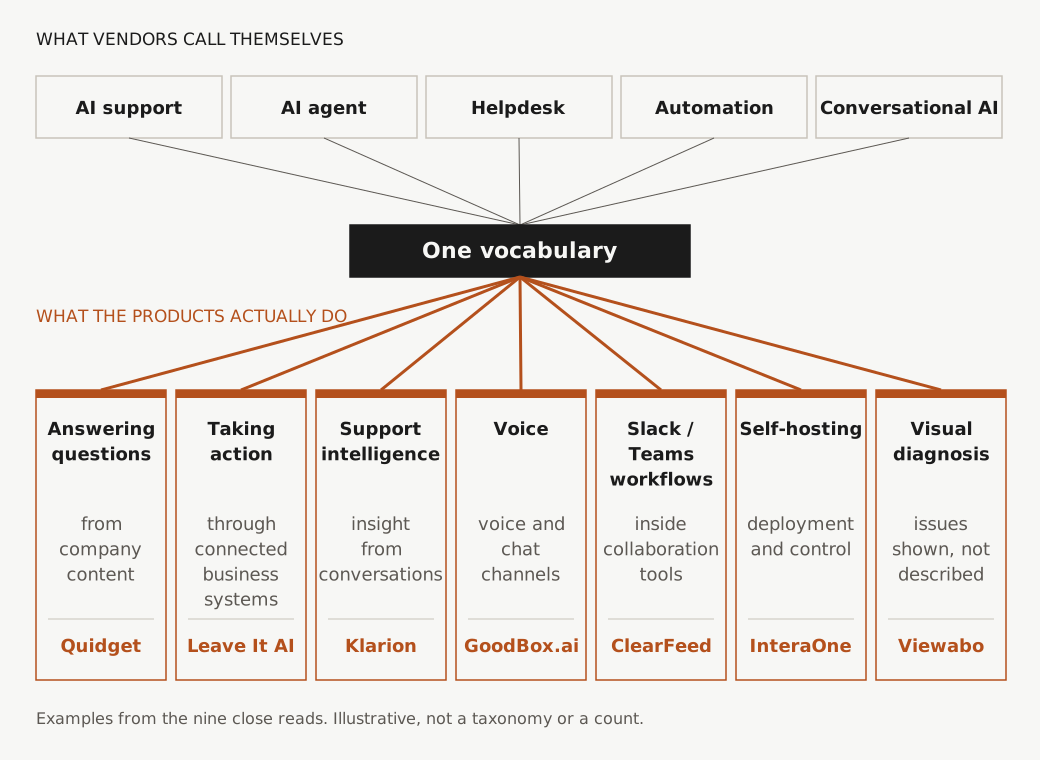
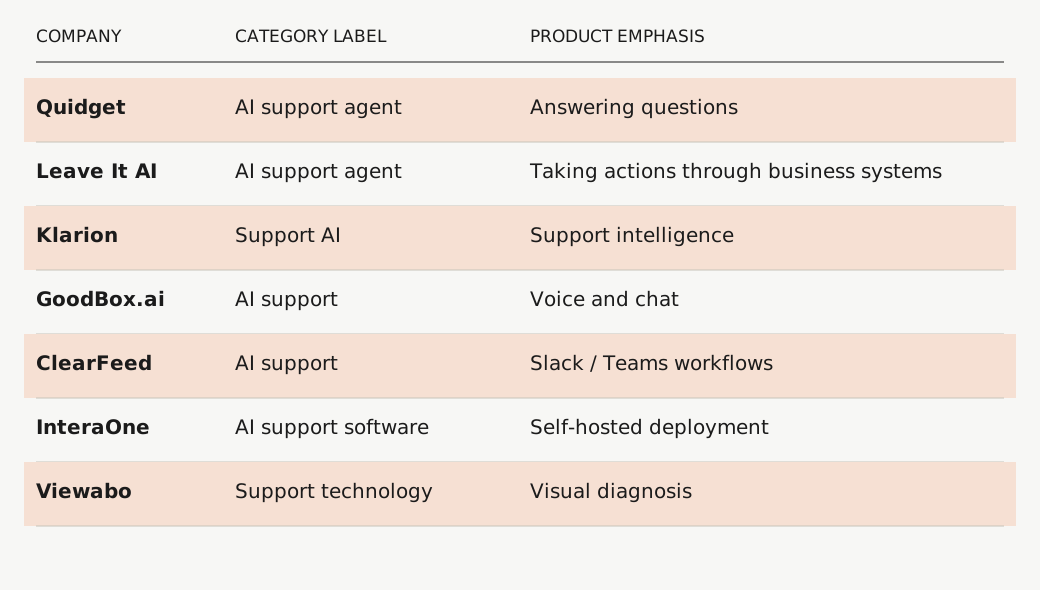
Positioning gives clues about fit. Slack and Teams suggest an operating environment, Shopify a commerce workflow, voice a support modality, self-hosting a deployment requirement. They are clues about the product. They are not evidence about who buys it.
04: What the Signals tell us about ICP
How do you get from a signal to a testable claim?
A single attribute is weak ICP evidence. “Ecommerce” says where a company sells, not what its support team struggles with. “50 to 200 employees” says how big it is, not whether it has the problem. The useful unit is an intersection: account, problem and workflow, then buyer and trigger.
This research supports the first three reasonably well. It is thin on the last two. Support Fabric shows the pattern: ecommerce founders, repetitive ecommerce support, Shopify and WooCommerce, with setup and maintenance handled for the customer. That is a precise claim, which makes it a testable one
05 : Four Hypotheses
Which account-plus-problem combinations are worth testing?
The four below are candidate ICP hypotheses. They are not segments, they are not ranked, and the dataset does not size them.
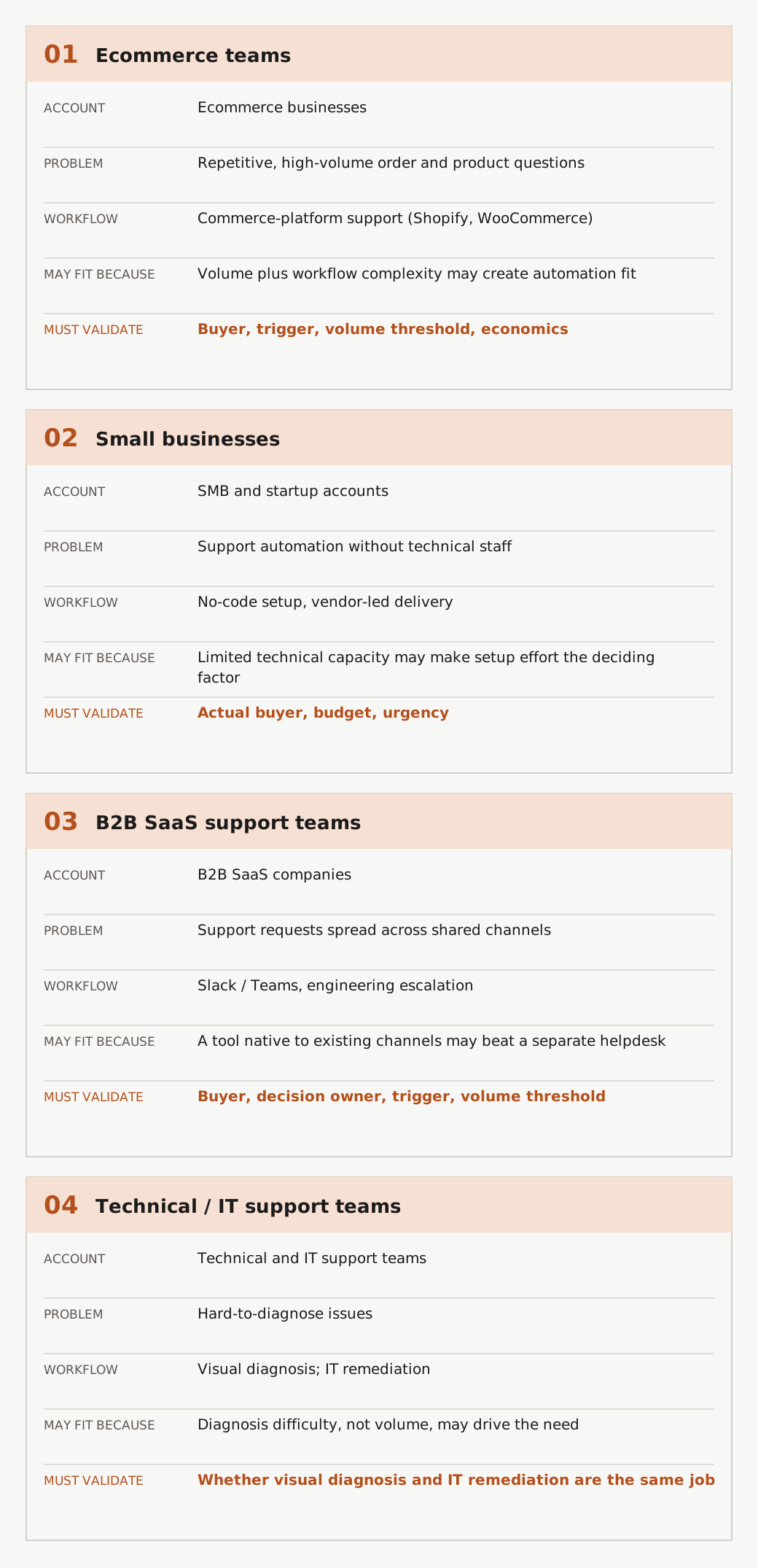
The aim is not to pick a winner from a vendor dataset. It is to write claims that customer evidence can break. The fourth is the thinnest: Viewabo and utilITise share an account type more than a problem.
06: The Evidence Boundary
What does this research establish, and what does it leave open?
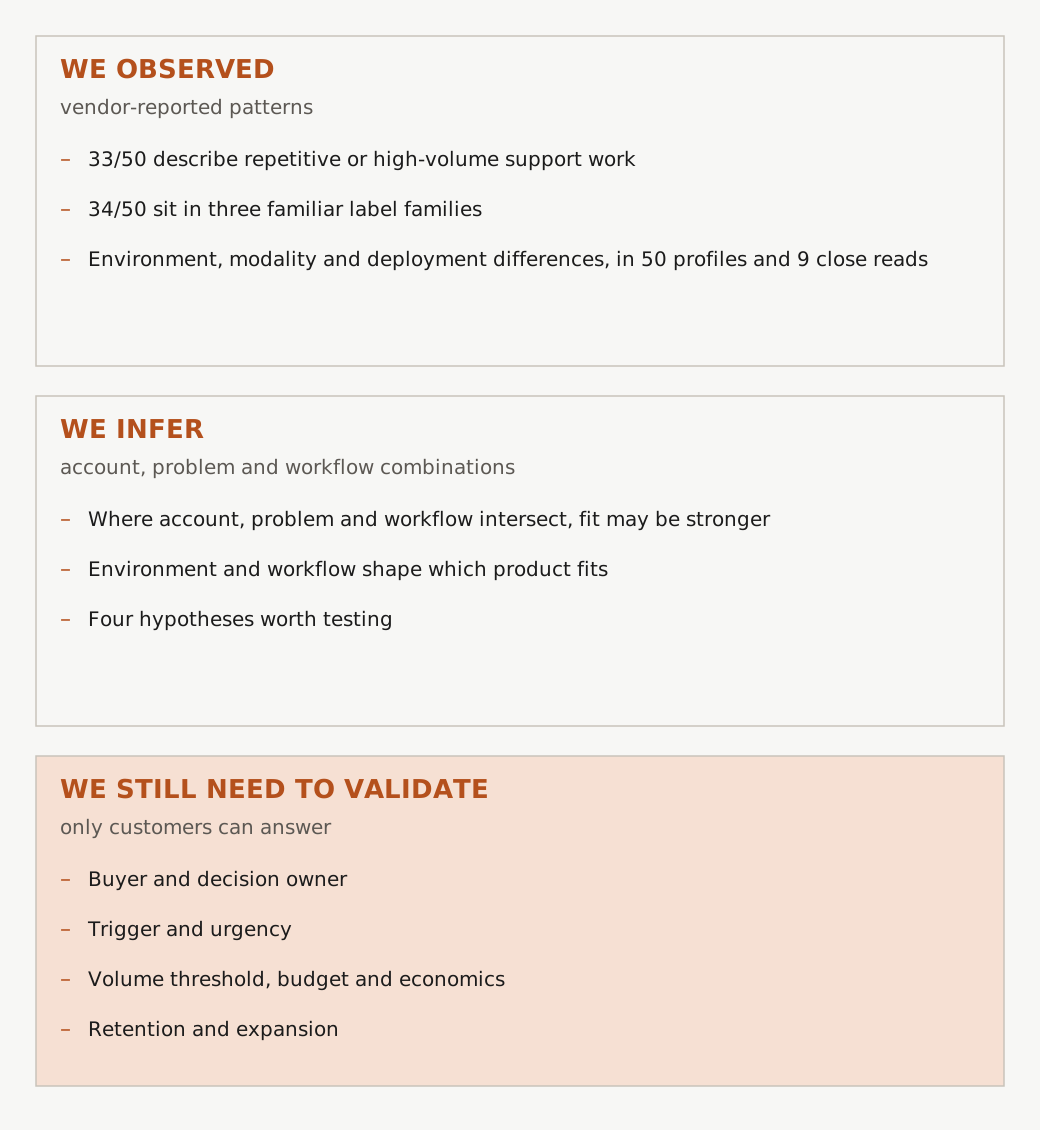
Four limits sit behind that boundary:
– The sample was screened with Eygentic’s existing ICP. It cannot independently prove a new one.
– The evidence is mostly vendor-written. Customer behavior was not directly observed, and no product was tested.
– The nine close reads illustrate. They show kinds of difference, not how common each is.
– Vendor size is not customer size. 38 of 50 vendors (76%) are recorded at 2–10 employees and 12 (24%) at 11–50. That describes the sellers.
07 : What We Would Test Next
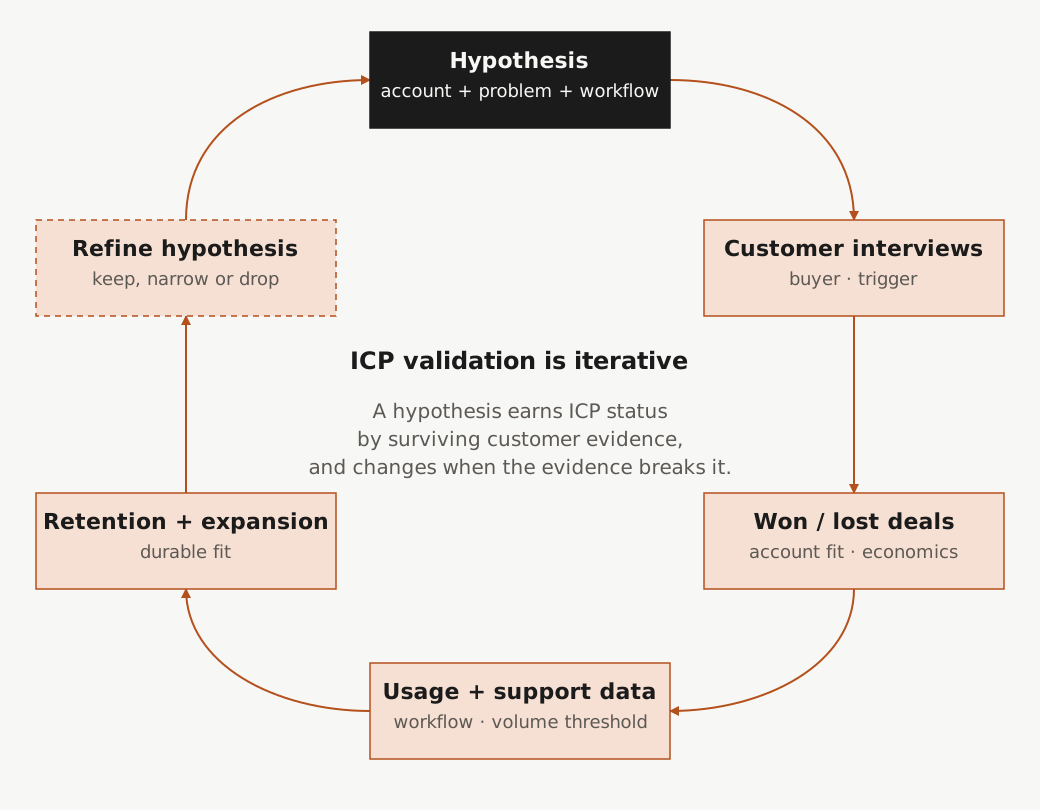
How do hypotheses become an ICP?
The weakest evidence is also the most important to an ICP: buyer and trigger. The next pass moves from vendor material to customers, and repeats.
| ICP Field | What We Have | What Would Validate It |
|---|---|---|
| Buyer | Vendor audience labels | Win/loss calls, contracts, decision-maker interviews |
| Trigger | Vendor language such as “growing volume” | Recent-buyer interviews, deal timelines |
| Account | Ecommerce, SMB, B2B SaaS, technical support | Won/lost deal data |
| Problem / Workflow | Repetitive volume; commerce, Slack, diagnosis | Usage and support data |
| Customer Proof | Limited | Retention and expansion |
8: Conclusion
Customer Support AI looks more uniform in its language than in its products. For ICP work, that makes “company type” the wrong unit of analysis. The useful unit is the intersection of account, problem, workflow, buyer and trigger.
Fifty vendors gave reasonable evidence on the first three and thin evidence on the last two. So the value of the research is not that we found the ICP. It is that we narrowed what to test: four hypotheses, and a short list of what customers must confirm.
“ Vendor research gives you questions. Customers give you the ICP. “
M E T H O D O L O G Y
Internal 50-company Customer Support AI dataset built from company-profile data and vendor materials reviewed in October 2026. We coded recurring patterns and read nine companies more closely: Quidget, Leave It AI, Support Fabric, GoodBox.ai, Klarion, Viewabo, InteraOne, ClearFeed and Travon AI. Percentages use 50 as the denominator. Categories overlap. The four hypotheses are qualitative: not segment sizes, market shares or validated segments. Companies named here can request corrections by contacting us.
Sources: http://quidget.ai · http://leave-it-ai.com · http://supportfabric.com · http://goodbox.ai · http://klarion.ai · http://viewabo.com · interaone.app · http://clearfeed.ai · travon.ai