How Customer Support AI Startups Differentiate When Everyone Says “AI Support”
A positioning collision study of 20 early-stage Customer Support AI startups
The easiest way to blend into the Customer Support AI market is to describe yourself exactly like everyone else. AI agents. Automated support. 24/7 service. Ticket resolution. Fewer repetitive tasks. All of these can be true, and still leave a buyer asking: why you?
We looked at 20 early-stage Customer Support AI startups to understand where their public positioning actually differs. The question was not which product is better. It was: when the category language sounds similar, what does each startup try to own?
The findings at a glance
- AI-agent or Customer Support AI category language: 20/20 startups (100%).
- Concrete workflow or job named: 19/20 (95%).
- Narrower ICP or target segment: 17/20 (85%).
- Action or execution language: 17/20 (85%).
- Specific channel or support surface: 13/20 (65%).
- Only 2/20 (10%) were coded as making a workflow/job their primary differentiation territory.
Overall pattern: Customer Support AI startups are increasingly specific about what they do, but the category itself still creates a lot of positioning collision.
1. “AI support” is everywhere
The strongest pattern was the simplest one: all 20 startups use explicit AI-agent or customer-support category language.
That is useful for category recognition. A buyer needs to understand what market they are looking at. But when every company can credibly say “AI support,” the phrase stops doing much differentiation work.
The same problem appears with adjacent language: AI agent, customer service AI, support automation, autonomous support and similar descriptions. They tell the buyer what the product is broadly. They do not necessarily tell the buyer why this product is the right choice.
2. Almost everyone has a workflow story, but that is not enough
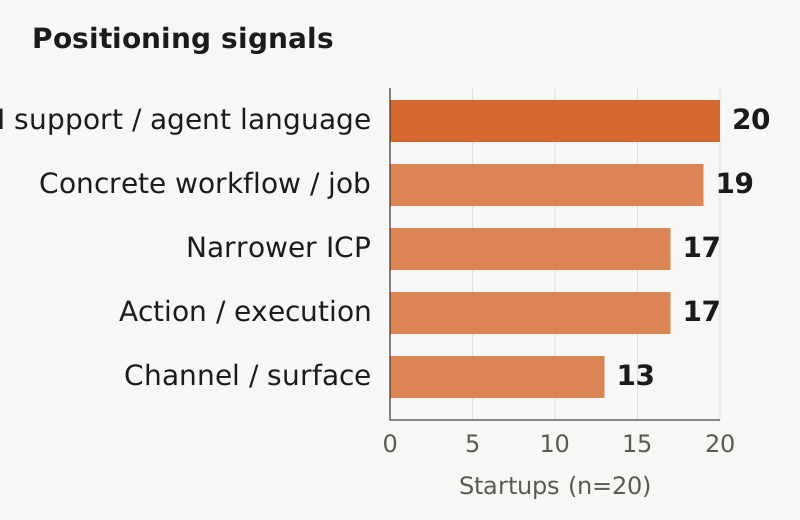
A concrete workflow appeared in 19 of 20 startups. That is important because it shows the market is moving beyond generic “AI for support” language.
But there is a difference between mentioning a workflow and making that workflow your territory. A company can say it resolves tickets, handles calls or automates support workflows while still positioning itself broadly.
So the useful GTM question is not simply “Do we mention a workflow?” It is “Would a buyer remember us for this particular job?”
3. The clearest escape route is a narrower customer
Seventeen of the 20 startups make a narrower ICP or target segment visible in their public positioning.
This is one of the clearest ways to move away from a generic category message. A startup that says it is for a particular kind of business, support environment or operating context gives the buyer a reason to see itself in the story.
That does not mean the research proves a particular ICP is better. It simply shows that narrower audience positioning is common among startups trying to establish a distinct wedge.
4. Where the positioning wedges actually sit
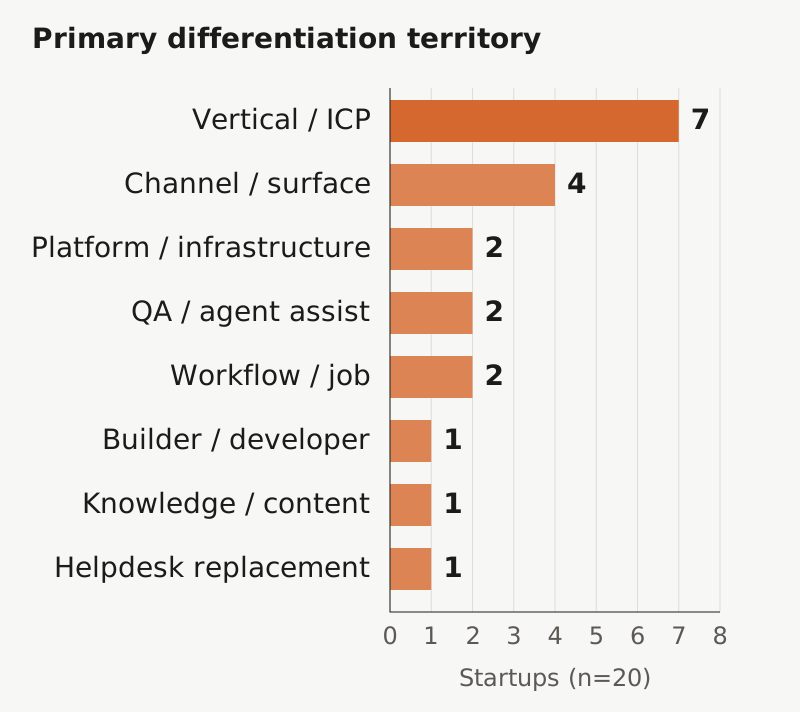
Vertical/ICP was the largest primary territory, with 7 of 20 startups (35%). Channel/surface followed with 4 of 20 (20%). The remaining startups were distributed across platform/infrastructure, QA and agent assist, workflow ownership, developer control, knowledge and helpdesk replacement.
The important point is that differentiation does not have to mean inventing a new AI capability. It can mean choosing a customer, workflow, channel or operating model that the company wants to be known for.
5. What positioning collision looks like in practice
Consider the difference between these two statements:
“We provide AI-powered customer support.”
versus
“We automate support for a specific type of business, in the workflow where its team spends the most time.”
The second statement is not automatically better. It is simply easier to differentiate because it creates boundaries. A buyer can understand who it is for, what problem it owns and where it fits.
That is the trade-off early-stage founders often avoid. Broad positioning feels safer because the product can serve many use cases. But broad positioning also gives competitors more room to sound the same.
6. The GTM problem: capabilities are not positioning
A Customer Support AI product may be capable of handling tickets, calling APIs, searching knowledge, routing issues, working across channels and taking actions.
Putting all of those capabilities on the homepage does not necessarily create a strong market position. It creates an inventory of things the product can do.
Positioning asks a different question: which of those capabilities should become the reason a specific buyer remembers you?
That is where GTM teams can get stuck. They keep adding features to the message instead of narrowing the message around a territory.
7. A simple way to test your positioning
Before committing to a new positioning statement, ask five questions:
- Could five competitors say the same thing?
- Does it make the target customer obvious?
- Does it name a specific job, workflow, channel or operating context?
- Is there a clear mechanism behind the claim?
- Can the sales and product teams actually prove it?
If the first answer is yes and the rest are weak, you probably have category messaging rather than differentiated positioning.
8. Don't differentiate the AI. Differentiate the job you own.
The research does not tell us which positioning strategy converts best. There is no win-rate, conversion or buyer-preference data in this study. What it does show is that the public category language is already crowded.
That makes the practical direction fairly simple: move down the positioning ladder.
AI support → AI agent → workflow automation → specific workflow + specific ICP/surface + clear mechanism/proof
The narrower end of that ladder is where a startup can start creating a reason to choose it.
The goal is not to stop saying “AI.” It is to make sure “AI” is not the most differentiated thing about the company.
9. What this research does and does not tell us
What it tells us
- The 20 startups use highly similar category language.
- Concrete workflows and narrower customer segments are common positioning signals.
- Vertical/ICP and channel/surface are the two largest primary differentiation territories in this sample.
- Startups use multiple mechanisms to create a wedge beyond the broad AI-support category.
What it does not tell us
- which positioning converts best
- which ICP has the highest willingness to pay
- whether buyers actually prefer one positioning
- market share or competitive performance
- a validated Customer Support AI ICP
10. Conclusion: the market is crowded, but the job does not have to be
Twenty startups can all sell “AI support” and still be solving very different problems.
One may want to own a vertical. Another may own a support channel. Another may build the infrastructure behind AI agents. Another may focus on QA, developer control, knowledge or a specific support workflow.
That is the opportunity for early-stage Customer Support AI companies. The answer to a crowded category is not another adjective for AI. It is a sharper choice about who you serve, what job you own and where your product is meaningfully different.
Don't differentiate the AI. Differentiate the job, customer, surface or operating context you own.
Methodology
We reviewed 20 active YC-listed startups with Customer Support AI, customer service or clearly support-centered positioning. The research is a public-positioning study based on current company descriptions reviewed in October 2026.
Category language, ICP, workflow/job, action/execution and channel/surface were coded separately. Each startup was then assigned exactly one primary differentiation territory based on the clearest positioning wedge on its public page.
The sample is not random and is limited to the YC ecosystem. Public positioning is seller-authored and can change over time. The findings should therefore be read as descriptive patterns in this n=20 sample, not as market-wide performance claims.