How Customers Actually Buy Customer Support AI
The easiest way to misunderstand the Customer Support AI market is to think buyers are shopping for AI. They are not. They are trying to solve a support problem.
A support team may be dealing with a sudden jump in volume. A company may need help around the clock without adding another shift. A chatbot may already exist but fail beyond basic questions. Or the support operation may have reached a point where adding more people no longer feels like the right answer.
Eygentic started with 50 documented Customer Support AI cases across the research set. After reviewing scope, 3 cases were excluded from the final buyer analysis, leaving 47 in-scope cases across 46 unique companies. The cases were published by Decagon, Sierra and Forethought and include Chime, Rippling, Duolingo, Notion, SoFi, Homebase, YNAB, ActiveCampaign, Upwork and Thumbtack.
The question: what problem was already happening before the AI solution entered the picture?
The findings at a glance
- Scale or support volume: 24/47 cases (51%).
- Existing support operation: 19/47 (40%).
- Top evaluation criteria: scale 17/47 (36%), CX/personalization 16/47 (34%), automation/deflection 14/47 (30%).
- Most common explicit objection: trust/quality, 4/47 (9%).
- Overall pattern: Customer Support AI is often a change-management sale, not a category-label sale.
1. Why do companies start looking for Customer Support AI?
The strongest pattern was not 'we want AI.' It was 'our current support model is starting to strain.'
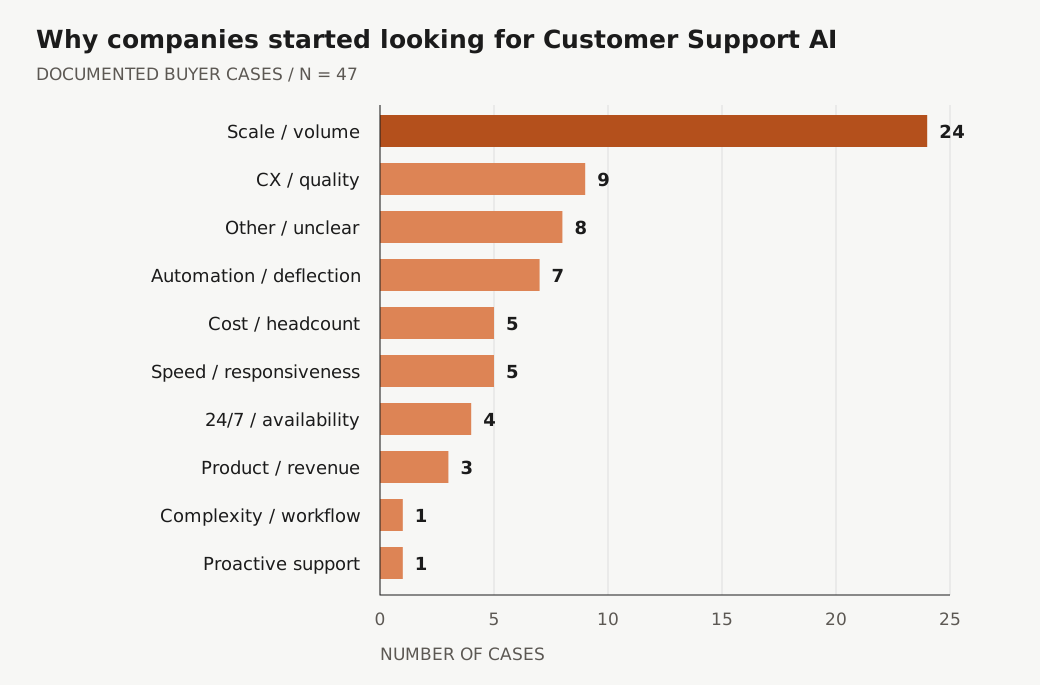
Scale or volume appeared in 24 of 47 cases (51%), the strongest recurring trigger. Chime's Sierra case describes high inbound volume, repetitive questions and long wait times. Vivid Seats needed to support millions of fans. Forma's case centers on rising member volume. Upwork needed faster resolution at support scale, while Thumbtack was rapidly scaling and deciding which tickets deserved human time.
Other triggers were more specific. Homebase wanted 24/7 support without the economics of full human coverage. Sun & Ski Sports faced recurring seasonal spikes and temporary hiring. Hertz focused on proactive resolution. Fourthwall wanted an always-online support agent.
GTM implication: lead with the operational trigger, not the technology category.
2. The real alternative is often the support operation already in place
The buyer is not always comparing one AI vendor with another. Often, the comparison is against the support operation already running.
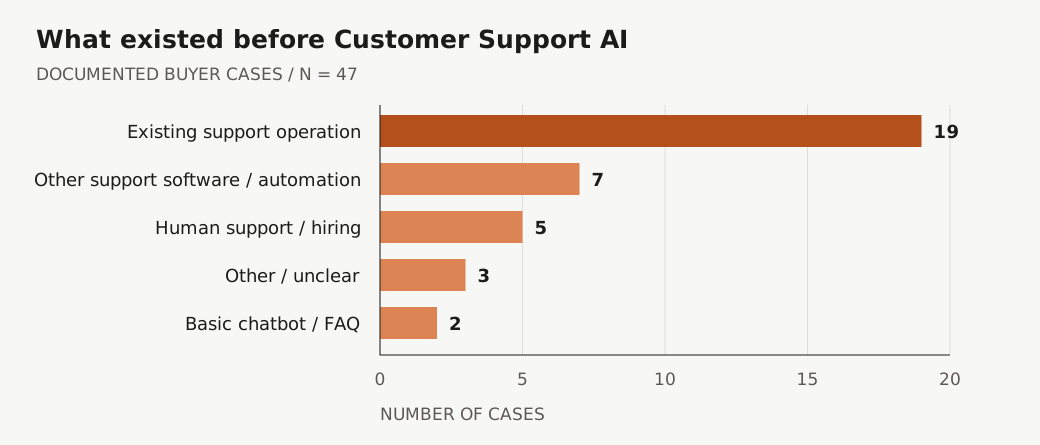
In 19 of 47 cases (40%), the documented alternative was an existing support operation. Another five cases (11%) explicitly referenced human support or hiring, while seven (15%) referenced other support software or automation.
YNAB had outgrown a basic chatbot. ActiveCampaign was already operating chat support and wanted to expand its AI program. Cotopaxi, YAZIO, Forma and Spordle are documented as evolving existing support operations.
Sierra's cases show the same pattern: SoFi, Homebase, Chime, ecoATM, Vivid Seats, Modern Animal and Next had support environments before or alongside the AI solution.
The competitor is often the status quo: people, processes, a chatbot or another support tool.
3. What actually matters when buyers evaluate a solution?
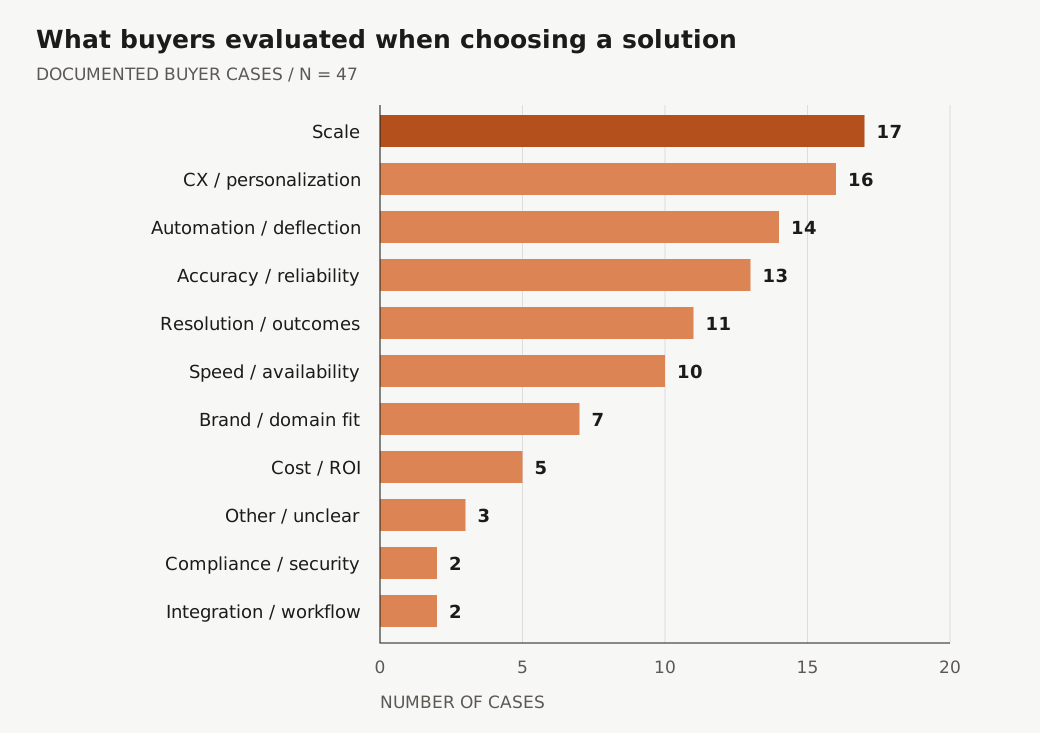
Scale was the most common criterion at 17 cases (36%), followed by CX/personalization at 16 (34%), automation/deflection at 14 (30%), accuracy/reliability at 13 (28%), and resolution/outcomes at 11 (23%).
Capital on Tap emphasized keeping the customer experience personal while growing at speed. BARK focused on customer experience and brand fit. Modern Animal wanted to bring humanity back to veterinary care while scaling support. Thumbtack's case emphasizes routing accuracy, speed and workflow compatibility.
“AI-powered” describes the technology. The evaluation criteria describe the buying decision.
4. Trust is not a side issue
The dataset does not establish that trust is the dominant objection across the market. It does show up repeatedly in the documented cases.
Trust/quality appeared in four cases (9%), accuracy/hallucination in three (6%), and compliance/safety in two (4%). Chime's case references hallucination resistance and accurate, personalized resolution. SoFi's case includes trust and regulatory suitability. ecoATM highlights preserving human support for complex issues. Sun & Ski Sports records internal stakeholder buy-in as a concern.
The practical lesson is not 'buyers reject AI.' It is that the sales motion has to make the boundaries, accuracy, escalation path and human role clear.
5. A more useful way to think about the buying journey
Trigger → Current approach → Evaluation criteria → Risk → Expected outcome
A company experiences a trigger: volume rises, response times worsen, staffing becomes expensive, or the existing chatbot hits a ceiling.
It compares the new option with what already exists: human support, hiring, a basic chatbot, another automation layer or the broader support operation.
Then it evaluates scale, customer experience, automation, accuracy, resolution, speed and fit. Finally come risks such as trust, hallucination, compliance, economics, workflow complexity, human handoff or internal buy-in.
For founder-led sales, this sequence is more useful than starting with a product demo.
6. What this means for Customer Support AI founders
1. Qualify the trigger before pitching
Ask what changed: volume, response time, staffing, 24/7 coverage, chatbot limitations or workflow complexity.
2. Identify the current alternative
Ask what happens if the prospect does nothing. The answer may be another hire, an existing chatbot, another automation tool or more work for current agents.
3. Sell against the evaluation criteria
If scale matters, demonstrate scale. If CX matters, demonstrate personalization. If accuracy matters, show evidence, boundaries and escalation.
4. Make risk explicit
Address trust, accuracy, compliance, economics, workflow and human handoff before they become objections.
5. Tie the product to an outcome
Use the metric connected to the original problem: deflection, resolution, response time, capacity, CX or ROI.
7. A simple framework for repeatable founder-led sales
| Question | What to learn |
|---|---|
| Trigger | What changed in the support operation? |
| Current approach | How is the problem handled today? |
| Evaluation | What will make the buyer say it works? |
| Risk | What could prevent adoption? |
| Outcome | What result needs to improve? |
This is a practical synthesis and a starting hypothesis, not a validated buying framework.
8. The companies behind the research
The research started with 50 cases. The final in-scope set contains 47 cases across 46 unique companies. Chime appears twice because it has documented cases with both Decagon and Sierra.
Decagon
Chime, Valon, Hunter Douglas Group, ClassPass, Rippling, Duolingo, 1-800-Flowers.com, Mercado Libre, SimplePractice, Rituals, Whop, Notion, Curology, Substack, Fourthwall, Flashfood, NG.CASH, Away, Hertz, Noom, Faire.
Sierra
SoFi, Homebase, Capital on Tap, Chime, BARK, ecoATM, Sutter Health, Woodside Collection, Modern Animal, Vivid Seats, Sun & Ski Sports, Next.
Forethought
YNAB, ActiveCampaign, Cotopaxi, YAZIO, Fetch, Forma, Spordle, Kickfin, iFIT, Achievers, Upwork, Lime, D2L, Thumbtack.
Three original cases were excluded from the clean Customer Support AI scope: Redfin, Kraken and RunBuggy.
9. What this research does, and does not, tell us
What it tells us
- The documented cases repeatedly connect adoption with operational pressure, especially scale and support volume.
- Most documented buyers were not starting from an empty slate.
- Scale, CX/personalization, automation, accuracy and resolution recur as evaluation themes.
- Trust, accuracy, compliance, workflow complexity, economics and human handoff appear as explicit concerns in a smaller number of cases.
What it does not tell us
- It does not establish a definitive ICP.
- It does not prove that similar positioning causes buyer confusion or reduces conversion.
- It does not establish budget ownership, willingness to pay or universal purchase triggers.
- It does not independently test product performance, autonomy, pricing or customer satisfaction.
- It is not a random sample of the Customer Support AI market.
10. Conclusion: buyers are not buying 'AI'
The most useful takeaway is that the buying context comes first.
Chime was dealing with volume, repetitive questions and wait times. Homebase was dealing with the economics of 24/7 coverage. YNAB had outgrown a basic chatbot. Forma needed to scale with member growth. Thumbtack needed to decide which support work deserved human attention. These are different problems, even though the solutions can all be described as Customer Support AI.
That is why a repeatable sales motion should begin with the customer's situation rather than the category label.
Trigger → Current approach → Evaluation criteria → Risk → Outcome
If founders can consistently identify that sequence, they have a stronger foundation for repeatable sales than a generic 'AI agent' pitch.
Methodology
Eygentic analyzed an internal dataset of 50 Customer Support AI company/customer cases and coded documented buying triggers, alternatives, evaluation criteria and objections. After scope review, 3 cases were excluded because they did not clearly fit the Customer Support AI buyer scope. This left 47 in-scope buyer cases representing 46 unique companies.
The source material consists primarily of first-party customer case studies published by Decagon, Sierra and Forethought. It should therefore be treated as documented buyer-case research rather than an independent market survey.
Three out-of-scope cases (Redfin, Kraken and RunBuggy) were preserved separately. Multiple codes can apply to one case, so category percentages are non-additive.
The original research set contains 50 cases; the final analytical dataset contains 47 in-scope cases.